AI Document Processing configuration
Contents:
- Recognition rules management
- Recognition rules setup
- Recognition results post-processing
- Recognition results conversion
- Advanced recognition settings
- Recognition tuning
About AI Document Processing
AI Document Processing, also known as Intelligent Document Processing (IDP), provides enterprise-grade capabilities for end-to-end processing of scanned and digitally generated documents.
It uses OCR, VL, AI-based classification, data extraction, and document understanding to transform documents in various formats into structured, machine-readable information for further processing, automation, search, and integration.
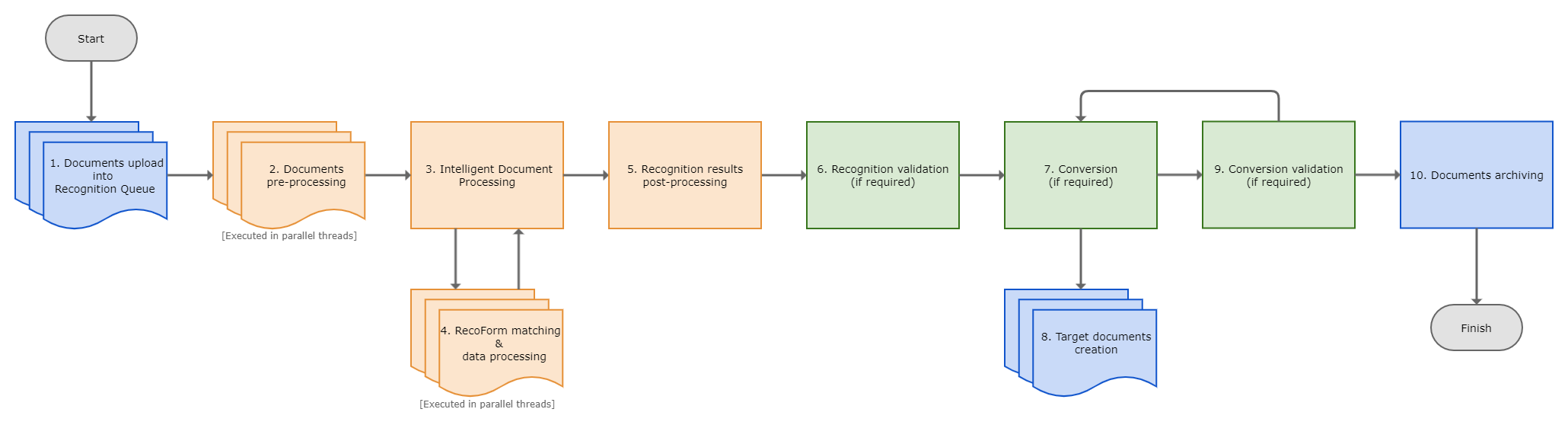
High-level AI Document Processing diagram
Supported OCR Engines
The elDoc IDP system supports multiple OCR engines, allowing flexibility in accuracy, performance, and deployment scenarios.
- Tesseract
elDoc IDP includes a built-in OCR engine based on the latest version of Tesseract, enhanced to deliver optimal recognition accuracy. (See Supported Languages below) - Google Vision API
elDoc IDP can be configured to use Google Vision API for OCR processing, providing high accuracy and robust language support. For more details and languages support, refer to Google Vision API Supported Languages. - PaddleOCR API
elDoc IDP can integrate with PaddleOCR, a high-performance open-source OCR framework optimized for multilingual text detection and recognition. PaddleOCR offers strong accuracy for complex layouts, supports a wide range of languages, and is particularly effective for structured documents and dense text scenarios. PaddleOCR can be also deployed on-prem. - VL Model API
Enables AI/LLM-based OCR using OpenAI API, leveraging vision-language models for advanced document understanding, including complex layouts, context-aware extraction, and semantic interpretation. VL model can be deployed on-prem using ollama, vLLM, llama.cpp, etc.
Tesseract Supported languages
Last modified: August 25, 2026